
Professorship of Biochemistry
Prof. Dr. rer. nat. Ewald Hannappel, Im Ruhestand
Institut für Biochemie
Professur für Biochemie und Molekulare Neurowissenschaften (Prof. Dr. Karow)
- E-Mail: ewald.hannappel@fau.de

Research Focus
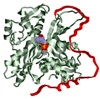
The beta-thymosins are a family of highly conserved polar 5 kDa peptides originally thought to be thymic hormones. About 10 years ago, thymosin beta-4 as well as other members of this ubiquitous peptide family were identified as the main intracellular G actin sequestering peptides, being present in high concentrations in almost every cell. Beta-thymosins bind monomeric actin in a 1:1 complex and act as actin buffers, preventing polymerization into actin filaments but supplying a pool of actin monomers when the cell needs filaments. Changes in the expression of beta-thymosins appear to be related to the differentiation of cells. Increased expression of beta-thymosins or even the synthesis of a beta-thymosin normally not expressed might promote metastasis possibly by increasing mobility of the cells. The ß-thymosins are extremely water soluble 5-kDa polypeptides. Thymosin beta-4, the most abundant member of this family, is expressed in most cell types and is regarded as the main intracellular G-actin sequestering peptide. In addition to this important intracellular function, there is increasing evidence for extracellular functions of beta-thymosins. For example, thymosin beta-4 increases the rate of attachment and spreading of endothelial cells on matrix components and stimulates the migration of human umbilical vein endothelial cells. We have shown that thymosin beta-4 can be cross-linked to proteins such as fibrin and collagen by tissue transglutaminase. Thymosin beta-4 is not cross-linked to a number of other proteins and its cross-linking to fibrin is competed by another family member, thymosin beta-10. After activation of human platelets with thrombin, thymosin beta-4 is released and cross-linked to fibrin in a time- and calcium-dependent manner. We suggest that thymosin beta-4 cross-linking is mediated by factor XIIIa, a transglutaminase that is co-released from stimulated platelets. This provides a mechanism to increase the local concentration of thymosin beta-4 near sites of clots and tissue damage where it may contribute to wound healing, angiogenesis and inflammatory responses.
Thymosin beta-4 possesses actin-sequestering activity and, like transglutaminases, is supposed to be involved in cellular events like angiogenesis, blood coagulation, apoptosis and wound healing. It serves as a specific glutaminyl substrate for transglutaminase and can be fluorescently labeled with dansylcadaverine. Two (Gln-23 and Gln-36) of the three glutamine residues are mainly involved in the transglutaminase reaction, while the third glutaminyl residue (Gln-39) is derivatized with a low efficiency. Labeled derivatives are still able to inhibit polymerization of G-actin and can be cross-linked to G-actin by 1-ethyl-3-[3-(dimethylamino)propyl]carbodiimide. Fluorescently labeled beta-thymosins may serve as a useful tool for further investigations in cell biology. Thymosin beta-4 could provide a specific glutaminyl substrate for transglutaminase in vivo, because of the fast reaction observed in vitro occurring at thymosin beta-4 concentrations which are found inside cells. It is under investigation if thymosin beta-4 may serve as a glutaminyl substrate for transglutaminases in vivo and play an important role in transglutaminase-related processes.
The ß-thymosins are extremely water soluble 5-kDa polypeptides. Thymosin beta-4, the most abundant member of this family, is expressed in most cell types and is regarded as the main intracellular G-actin sequestering peptide. In addition to this important intracellular function, there is increasing evidence for extracellular functions of beta-thymosins. For example, thymosin beta-4 increases the rate of attachment and spreading of endothelial cells on matrix components and stimulates the migration of human umbilical vein endothelial cells. We have shown that thymosin beta-4 can be cross-linked to proteins such as fibrin and collagen by tissue transglutaminase. Thymosin beta-4 is not cross-linked to a number of other proteins and its cross-linking to fibrin is competed by another family member, thymosin beta-10. After activation of human platelets with thrombin, thymosin beta-4 is released and cross-linked to fibrin in a time- and calcium-dependent manner. We suggest that thymosin beta-4 cross-linking is mediated by factor XIIIa, a transglutaminase that is co-released from stimulated platelets. This provides a mechanism to increase the local concentration of thymosin beta-4 near sites of clots and tissue damage where it may contribute to wound healing, angiogenesis and inflammatory responses.